
“I figure that I want to swim as well as I can against the tides. I’m not trying to predict the tides.”
– Charlie Munger
Stormy Clouds, Rose-Tinted Markets
Much like its predecessor, 2026 has so far been a year of market euphoria in the face of severe geopolitical tension. One month after capturing Venezuela’s president Nicolas Maduro, the US attacked Iran alongside Israel, killing the country’s supreme leader and plunging the region into turmoil. The conflict has had a marked impact on commodity prices, with oil surging as a result of Iran’s closing of the Strait of Hormuz, a vital shipping corridor through which one-fifth of global oil demand passes. While crude prices have pulled back from their highs, inflation expectations remain elevated as the two countries continue to exchange strikes despite several attempts at a ceasefire.
Trump’s tariffs have also been impacting prices despite the US Supreme Court ruling most of them illegal in February, with the administration reimposing temporary tariffs under different legislation. The US also announced that it would not renew CUSMA, the North American trade deal under which ~90 per cent of Canadian exports to the US have remained tariff-free. Importantly, the deal will (for now) remain in effect until 2036, and Canada has wasted no time in courting new trade partners. Still, the frayed relationship with the US has contributed to underwhelming investment and concerns that companies may soon move operations to the US, with one KPMG survey finding that 42 percent of Canadian manufacturing firms have, or are considering, relocating to the US.
As formidable as these headwinds may be, they have done little to deter investors. In the US, semiconductor companies have driven the S&P 500 to new highs thanks to a fervent build out of AI infrastructure; four US tech companies alone are set to spend $650 billion on AI infrastructure this year, while startups Anthropic and OpenAI have both filed to go public. Concerns over valuations remain (Elon Musk’s SpaceX immediately hit markets as one of the top ten most valuable US stocks, despite revenues not even cracking the top 200 list), especially as value-focused stocks have sold off despite strong earnings.
In Canada, stocks have likewise performed well despite the country experiencing a technical recession in the first quarter, with higher oil prices and new pipeline announcements bolstering the country’s energy sector. Prime Minister Mark Carney has also sought to reinvigorate investment in the country with a series of initiatives, including a new sovereign wealth fund, and a more-controversial plan to purchase unsold condos in BC.
Anxieties over high AI expectations and geopolitical events continue to battle with optimism over the tech revolution. 2026 is set to be another year for the books.
As always, we thank you for your support and continued confidence in WDS.
Equities
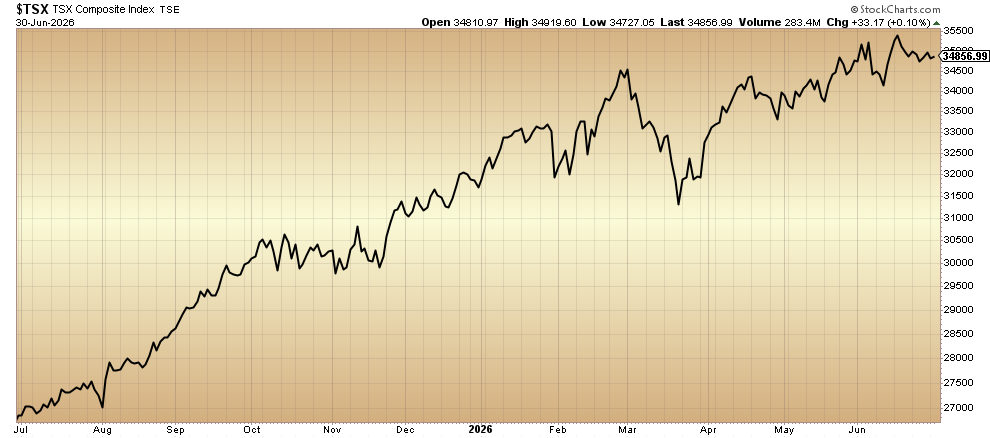
Despite the Canadian economy experiencing two consecutive contractions in quarterly GDP, the S&P/TSX Composite Index ($TSX) managed to achieve a solid 9.9 per cent price return in the first half of the year, with dividends bringing the total return to 11.2 per cent. Energy and financials both managed to achieve a roughly 21 per cent jump, the strongest among the sectors, with the former benefiting from the war in Iran’s impact on oil prices, and the latter from higher interest rates and a resilient Canadian market in the face of tariffs. Information technology meanwhile was the worst performing sector, dropping 17.6 per cent in part due to the areas limited exposure to AI, which is crowding out the space.
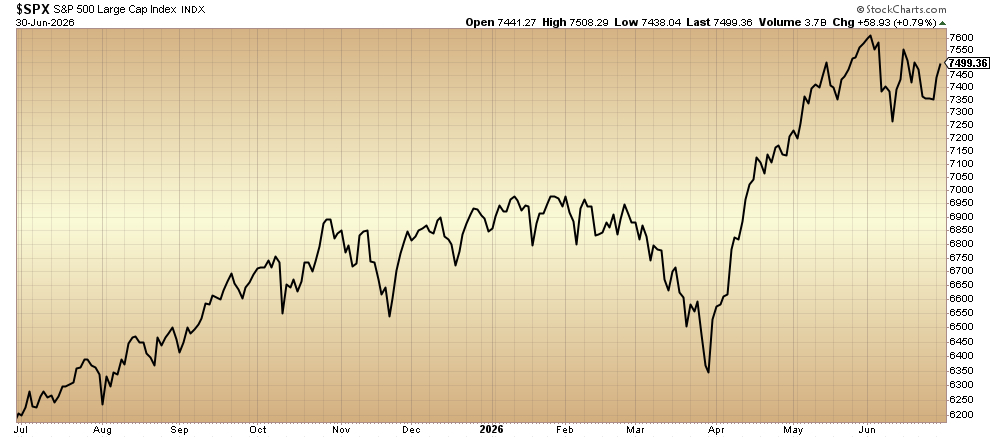
Markets achieved similar performance south of the border, with the S&P 500 ($SPX) seeing a total return of 10.2 per cent, albeit that figure jumps to 14.1 per cent in Canadian dollar terms. Optimism around AI has driven the performance, masking weaker returns from software stocks and value-oriented positions.
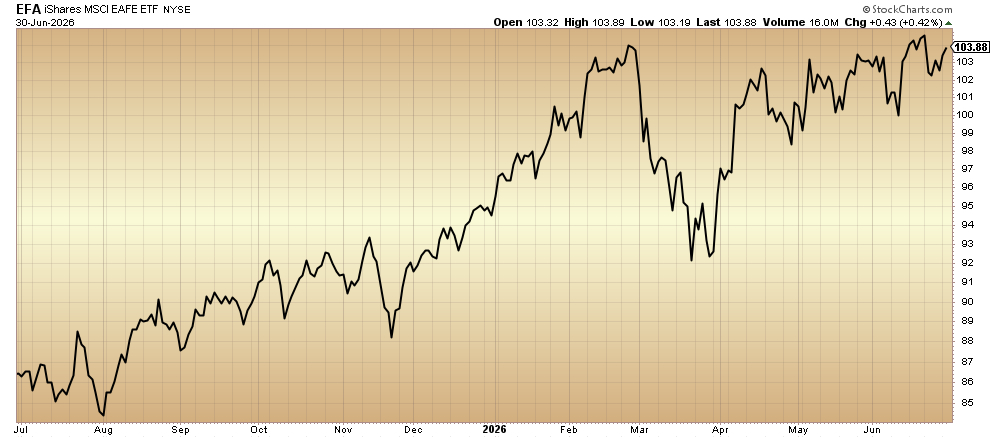
Outside of North America, the MSCI EAFE Index (represented by the EFA ETF chart) rose 9.8 per cent on a gross return US dollar basis (13.7 per cent in Canadian dollars). Markets around the world similarly saw a dip in March amid the conflict in the middle east, with energy importers being hit the hardest, but were generally helped by strong performance from Japan, which saw stocks rise nearly 40 per cent year to date.
Fixed Income and Interest Rates
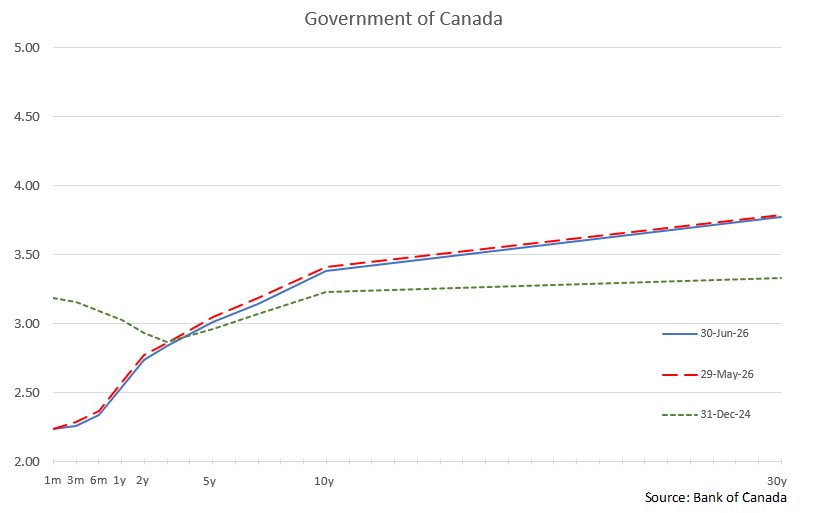
Facing a mixed case for changing rates, the Bank of Canada opted to maintain its policy rate of 2.25 through the first half of the year. On the one hand, the country experienced a technical recession in Q1 and continues to grapple with the depressing impact of tariffs and the country’s first ever population decline since confederation (partly the result of changes to temporary immigration policy). On the other hand, tariffs and the war in Iran contributed to higher headline inflation of 3.2 per cent in May, while early data suggests economic activity improved in the second quarter, both of which should encourage the central bank to hike rates.
Yields have not changed much in Canada, with the 10-year treasury bond seeing its yield fall slightly to 3.4 per cent in the first half of the year. The low rates should benefit the government’s infrastructure investment plans, with the government announcing plans to kickstart a sovereign wealth fund, among other initiatives, to bolster investment in the country’s infrastructure.
The US Federal Reserve meanwhile now has a new chair, Kevin Warsh, who many feared would aim to appease Trump’s desire for lower rates despite inflationary pressures. Nonetheless, the bank’s target range was kept at 3.50 to 3.75 per cent in the first half of 2026, with the Chair signalling an intent to keep prices in line. Treasury yields have remained elevated, however, with the 10-year bond sitting at 4.4 per cent, with economists anticipating several rate hikes in 2026.
Currencies
Canada’s inflation data paints a mixed picture, but has been more muted than in the US. Amid tariffs, the war in Iran, and easing unemployment (6.5 per cent as of June), headline inflation has been ticking higher, reaching 3.2 per cent as of May. Volatile categories have had an outsized impact on the figure, however - stripping out food and energy, core inflation has actually been on the decline, reaching 2.2 per cent in May after topping nearly 3.0 per cent in 2025. Total exports have also recovered from the initial impact of tariffs, reaching $77.1 billion in March, compared to $73.1B in January, the month before the trade war with the US kicked off.
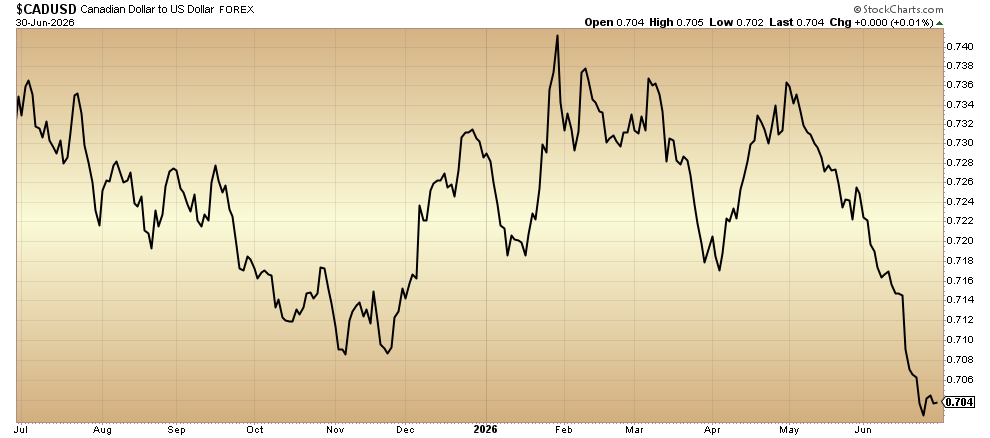
Trade in the US has likewise been normalizing despite ongoing protectionist efforts, with the trade deficit returning to -$77.6 billion as of May, roughly the same level it was before Donald Trump’s election. Headline and core inflation has meanwhile cooled slightly from more-elevated levels, reaching 3.5 per cent and 2.6 per cent in June, respectively. Despite seeing lower inflation rates, the Loonie has weakened against the Greenback, falling 3.5 per cent year to date to 70.4 cents USD in the first half of the year, the result of slower economic activity and higher interest rates in the US (something that attracts US dollar demand).
Commodities
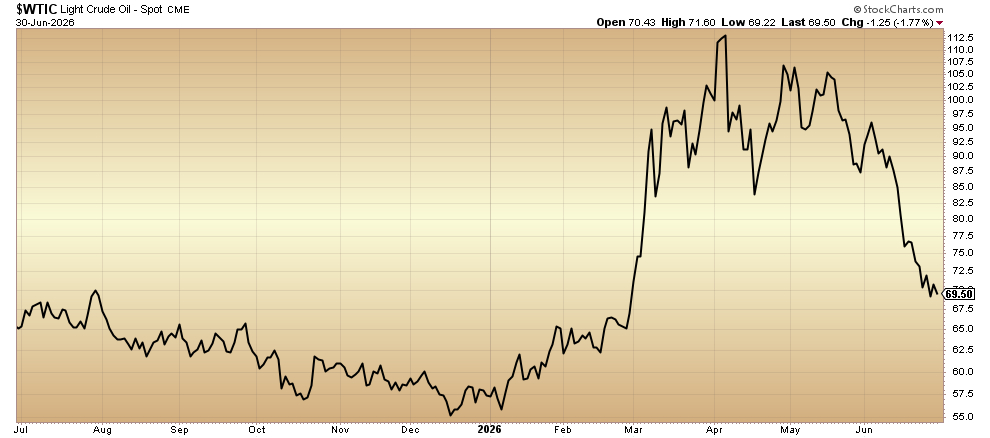
Oil prices surged in 2026, more than doubling from $57.40 a barrel as of 2025 year end to a high of $119.47 a barrel in April as the US and Israel initiated their war with Iran, resulting in the closure of an important commodity passageway, the Strait of Hormuz. Liquified natural gas and fertilizers have also been impacted, and while oil prices settled to $69.50 (up 21.0 per cent year to date) following a series of ceasefire attempts, peace has so far failed to hold. Countries are managing the oil shortage by tapping reserves, but prices will likely push higher again as levels begin to dwindle if the Strait remains closed.
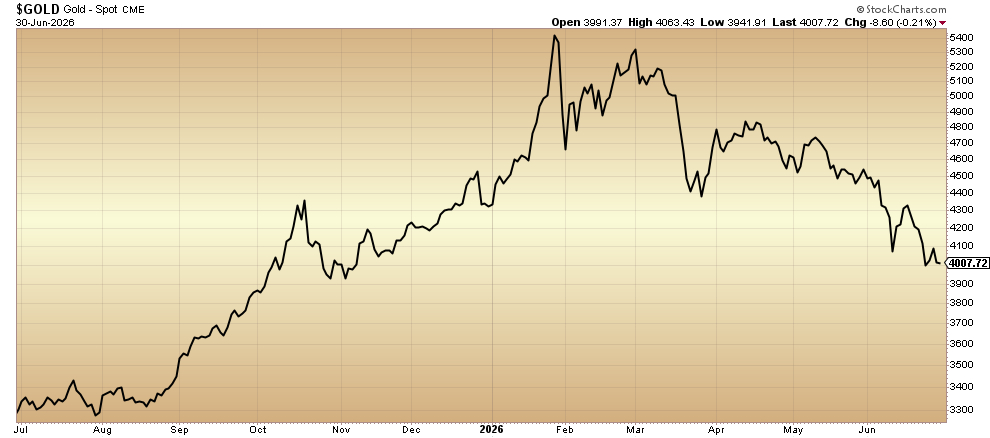
Gold reached an all-time high in January of over $5,500 per troy ounce before sliding, ending the first half of 2026 down 6.8 per cent year to date at $4,016.7 per troy ounce. The precious metal benefitted from increased buying from both central banks and retail investors through 2025, but saw central banks become net sellers in March, depressing the asset’s price despite the outbreak of the war in Iran, challenging the metal’s safe haven status. Bitcoin, which some view as a successor to gold, fared even worse – the cryptocurrency has fallen 32.6 per cent year to date.
This report is provided for your information. Conclusions and opinions given do not guarantee future events or performance. Facts and data provided are from sources we believe to be reliable, but we cannot guarantee they are complete or accurate. This report is not to be construed as an offer to sell or a solicitation of an offer to buy any securities. Before making an investment or adopting an investment strategy, each investor should review his investment objectives with their investment advisor. Watson Di Primio Steel (WDS) Investment Management Ltd. and individuals and companies who are related may, at any time, buy or sell securities that are hereby described in this report.