
“Courage taught me no matter how bad a crisis gets… any sound investment will eventually pay off.”
– Carlos Slim Helu
COVID-19 in 2022 – Here We Go Again
“Okay, campers, rise and shine, and don't forget your booties 'cause it's cooooold out there today!” Much like Bill Murray’s Groundhog Day, 2022 has so far started off sounding like a repeat; thanks to a record-breaking surge in COVID-19 cases, new lockdown rules are going into effect to curb the spread. Behind the latest wave is Omicron, a new variant that is believed to be more transmissible. Thankfully, the World Health Organization is seeing early signs that the variant causes relatively milder symptoms than previous strains, something that appears to reflect in the data; while daily new cases have quadrupled from their previous high in Canada, new deaths sit at roughly 20per cent of their early 2020 peak. Vaccines have been helping as well, and while less effective against the strain, boosters have shown to still provide 75 to 80 per cent protection against severe disease from Omicron.
While COVID-19 may have consumed 2021 headlines, the year was eventful for other reasons. Early in the year we saw Biden come into office, as well as the rise of so-called “meme stocks” such as GameStop. This speculative demand for unconventional positions also brought about the rise of the NFT or nonfungible token, a blockchain-hosted digital collectible that has become a hotbed for pump-and-dump schemes. We also saw the “the Great Resignation,” where a record-breaking number of Americans left their jobs to take advantage of higher wages elsewhere. There is also of course China, which is still reeling from the collapse of its second largest real estate developer, “Evergrande,” and who squashed investor enthusiasm after cracking down on its own tech stocks and US-based IPOs. Then there was inflation - through 2021 consumer prices rose at levels not seen in decades, with November seeing a 4.7 per cent year-over-year increase in Canada and a 6.8 per cent jump in the US. Supply chain disruptions from COVID have played a role, but with many economies roaring back from their 2020 slumps, it appears as though stimulus measures may have caused things to overheat; the Federal Reserve has already drastically cut their timeline for rate hikes to try and cool things down.
Despite the turmoil, North American markets had a spectacular year, with investors maintaining an appetite for risk. Unlike in Groundhog Day, however, it is impossible to know what tomorrow will bring, so we will continue to focus on prudently investing in quality businesses – from our home offices for now, of course.
As always, we thank you for your support and continued confidence in WDS.
Equities
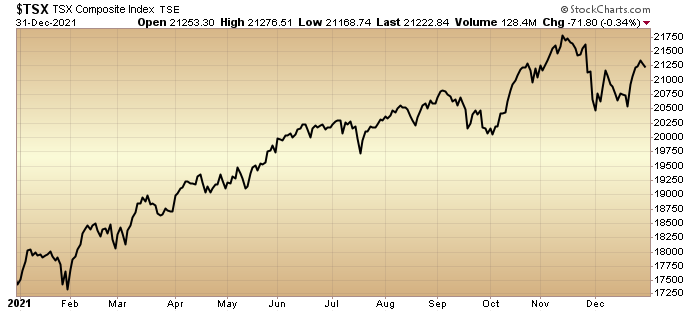
It was a very good year for stocks. Thanks to an early year vaccine rollout and high commodity prices, the Canadian S&P/TSX Composite Index ($TSX) climbed steadily, ending the year at 21,223, a return of 21.7 per cent. With dividends, that figure rises to 25.1 per cent.
Leading the charge was energy, which rebounded by 41.8 per cent during the year as the economic re-opening and supply constraints boosted prices. Most other sectors had solid double-digit returns, too. The one blemish? Health care, interestingly enough, which fell 20.1 per cent in 2021; as cases surged, many businesses that focus on elective procedures and retirement residences (yes, most of those are classified as health care stocks) saw earnings collapse.
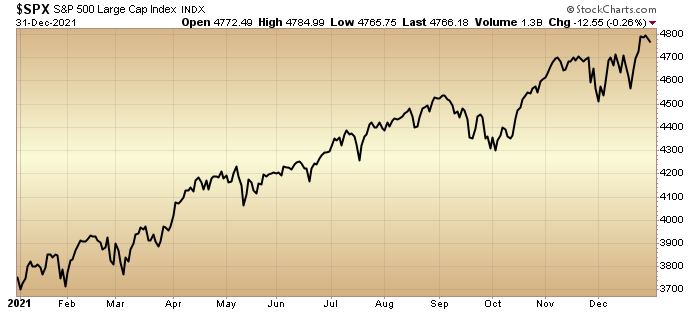
Performance was even more impressive South of the border, where the S&P 500 Index ($SPX) achieved a total return of 28.7 per cent (27.6 per cent in Canadian dollar terms). The return has inflated valuations, however; the Cyclically-Adjusted Price-to-Earnings or CAPE ratio, an indicator of how “pricey” markets are, sits at 39.5x in the US, just 5 points away from the record high achieved in 2000.
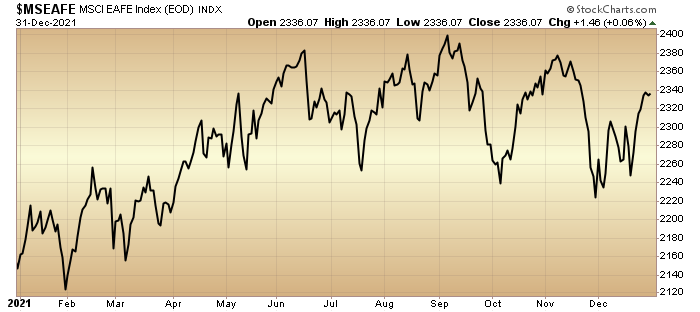
Internationally, the MSCI EAFE Index ($MSEAFE) rose 11.8 per cent (total return) in U.S. dollar terms, while the Shanghai index remained relatively flat for the year. The weaker performance in China is no surprise; with the country’s real estate debt collapse, regulatory crackdown on tech firms, banning of some US listings and strict “Zero COVID” policy, returns have been less than spectacular in the region.
Fixed Income and Interest Rates
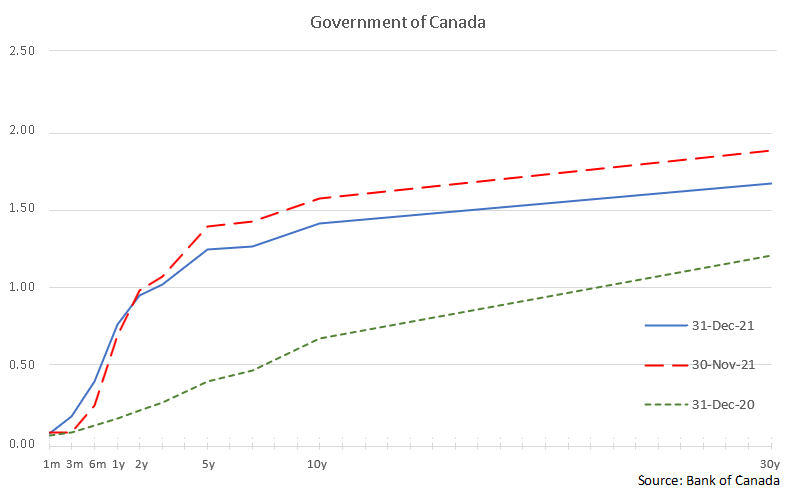
2022 is likely to be the year central banks finally start hiking rates. A period of low interest rates (currently 0.25 per cent), fiscal stimulus and supply chain constraints have caused inflation to rear its ugly head in Canada, with the Consumer Price Index jumping 4.7 per cent year-over-year in November, a quarter of which came from gasoline alone. The relatively new Bank of Canada governor Tiff Macklem has already ended the country’s quantitative easing program in October in response, and with unemployment near its pre-pandemic level, there is perhaps further room for cooling. Real estate is the main point of contention, however; with high debt levels and 10 per cent of Canada’s GDP coming from housing, the Bank of Canada could cause collateral damage with hurried hikes.
Tighter monetary policy expectations have dragged down bond prices. The FTSE TMX Canada Universe Bond Composite Index fell 2.8 per cent over 2021. With lower prices, 10-year Canada bond yields have climbed 75 basis points to 1.43 per cent.
With the US still tapering its own bond purchases, it appears further away from rate hikes than Canada, but meeting minutes suggest the Federal Reserve will be speeding up its wind down in an attempt to combat inflation, which reached a 39-year high of 5.7 per cent in November. While Chair of the Federal Reserve Jerome Powell initially guided for rate hikes no earlier than 2023, some are speculating we may see the first hike in March this year.
Currencies
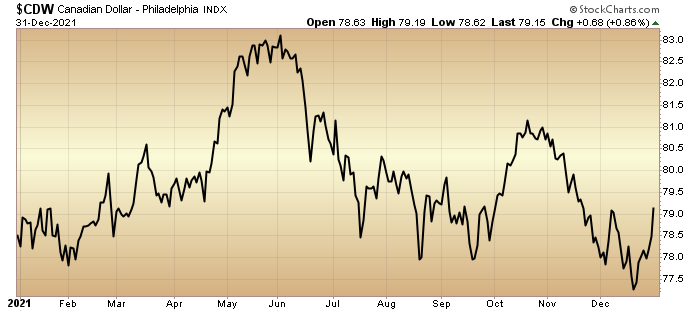
The Canadian dollar ($CDW) ended 2021 mostly flat at $0.79 USD, though it was far from a quiet ride for the loonie. The currency moved in step with oil prices, rallying with the commodity in the second quarter, and again in October, but likewise sliding each time crude fell from its peak. By year end, the loonie was up a marginal 0.8 per cent, this despite oil retaining much of its own gain, with the US dollar strengthening on expectations of sooner-than-anticipated rate hikes.
Meanwhile, trade in Canada ended 2021 with a bang; in November, the country posted its largest trade surplus ($3.13B) in over 13 years, with exports growing 3.8 per cent from October. Even more impressive is the fact this growth occurred in the same month as British Columbia’s flooding, a natural disaster that caused widespread transportation disruptions and temporarily cut off access to Vancouver, Canada’s largest port.
Commodities
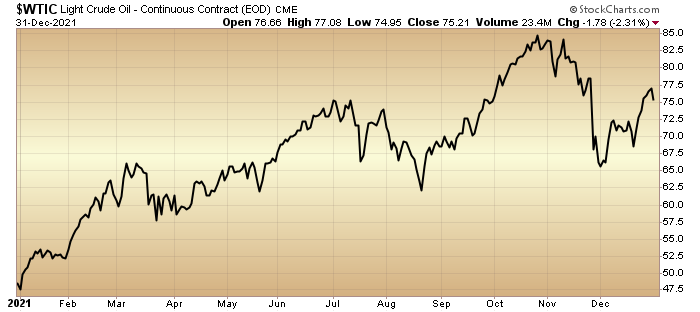
Crude oil had a particularly strong year, with the West Texas Intermediate ($WTIC) ending 2021 at $75.21 USD a barrel, up 55.0 per cent annually. The rally is one-part economic recovery and one-part supply constraints, not only because of COVID-related disruptions (many producers, including OPEC, reduced output during the pandemic), but also because of investor pressure on oil companies to pull back on their spending. Now that prices are higher, it will take some time for production to ramp back up. Some even question if OPEC will meet their newly-raised targets.
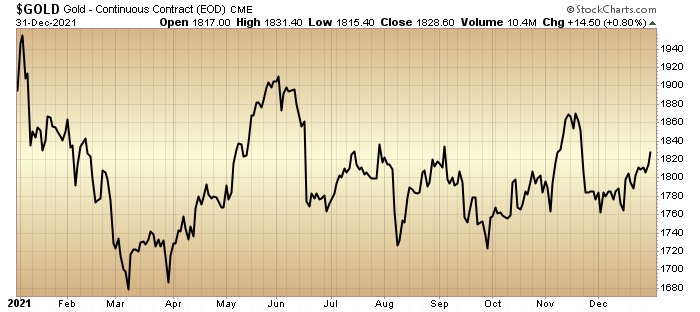
Meanwhile, gold prices ($GOLD) are sure to be disappointing the most cautious of investors. Despite the eye-watering rise in consumer prices, the precious metal is actually down 4.0 per cent for the year, violating the long-held belief that gold should rise in value with inflation. More likely than not, investors were lured into other high-flying markets during the year, with some even speculating that cryptocurrencies have taken a larger share of the “safe haven” market.
It is also worth touching on the energy crisis in Europe, where European Union natural gas import prices have jumped over 500% through 2021to a level well above previous peaks. Strong demand and supply constraints are to blame for the surge, and with Russia (a key supplier) reluctant to boost production, countries around the world are starting to be affected by the energy crunch, this despite the regional-nature of natural gas prices.
This report is provided for your information. Conclusions and opinions given do not guarantee future events or performance. Facts and data provided are from sources we believe to be reliable, but we cannot guarantee they are complete or accurate. This report is not to be construed as an offer to sell or a solicitation of an offer to buy any securities. Before making an investment or adopting an investment strategy, each investor should review his investment objectives with their investment advisor. Watson Di Primio Steel (WDS) Investment Management Ltd. and individuals and companies who are related may, at any time, buy or sell securities that are hereby described in this report.