
“The individual investor should act consistently as an investor and not as a speculator.”
–Benjamin Graham, author and economist
Transition - Make Stocks Great Again?
Oh what a difference six months can make! Investors’ nervousness at the start of the year gave way as stability returned to commodities. After hitting what appeared to be a bottom in February, oil prices started to recover and so did investors’ appetite for risk assets. Then as the summer receded the U.S. presidential election looked to be the major risk that kept the general view cautious, and a lid on the market.
Normally markets don’t take kindly to change. Nothing seemed more unlikely than a U.S. government led by Donald Trump. So in the run up to Election Day, markets largely ignored this potential outcome. Trump won. Strangely enough the market’s reaction proved to be the opposite of what (again) the ‘experts’ had predicted. Instead of an uncertainty-induced downward slide, the markets not only digested the shocking news but have since all but taken off.
Given the recent strength, the question on everyone’s mind is how long this rally will last. Much like the outcome of elections, the short-term trajectory of the market is famously hard to predict. Given Trump’s stance on corporate tax cuts, higher infrastructure spending and looser regulatory grip; it is no wonder that many business leaders are optimistic of the mid- to long-term earnings outlook. Can the new Government deliver the promised pro-business and pro-growth environment needed to spur real growth? Given political and structural challenges; others see this rally as short-lived.
If there is one lesson from prediction error in 2016 it is ‘pay attention to uncertainty’. Elections like markets are fraught with complexity so that even ‘expert’ guesses are frequently wrong. And like pollsters, financial pundits are not clairvoyant. Investment decisions should be based on investment principles, not boom or bust predictions.
In his classic 1934 book, “Security Analysis”, the great investment analyst Benjamin Graham wrote: “An investment operation is one which, upon thorough analysis, promises safety of principal and a satisfactory [or ‘adequate’] return. Operations not meeting these requirements are speculative.” We proceed cautiously given the market’s rise and remain optimistic on the ability to find quality investments that provide long-term growth and income potential.
As always, we thank you for your support and continued confidence in WDS.
Equities:
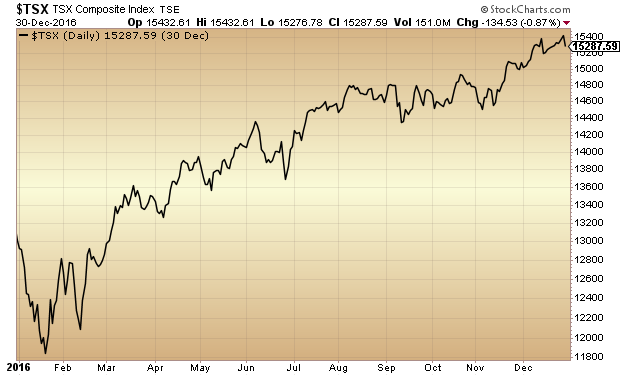
Canada’s market remained a top performer among global developed economies in 2016. Reversing its trajectory after February, the S&P/TSX Composite Index ($TSX) ended 2016 strong with a 17.5 per cent price return. Include dividends in the mix (total return) and the TSX delivered 21.1 per cent. The resurgent energy sector—a key contributor--saw gains of 31.3 per cent for the year. With interest rate hikes expected, the traditional yield-sector utilities and telecom services stocks underperformed the overall market with returns of 13.5 and 9.9 per cent, respectively. On the other hand, the rate hike forecasts acted as a tailwind for the financials sector, closing up 18.3 per cent.
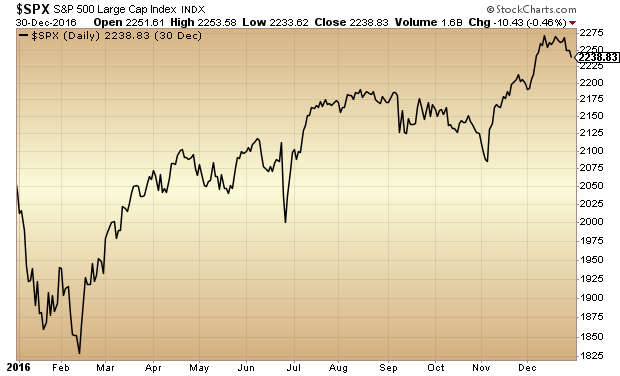
The U.S. market was on equally shaky ground to start but, like here at home, reversed course rapidly. The U.S. composite index is not as levered to oil, leading to its relative underperformance compared to Canada. With a strong finish, the S&P 500 Index ($SPX) ended the year up 9.5 per cent (US$) on a price return basis and 12.0 per cent (US$) on a total return basis. Perhaps more relevant to Canadian investors, the S&P total return for this year was 8.8 per cent on a Canadian dollar basis. Industrials and financials are expected to be beneficiaries of the incoming Trumpenomics platform. Not surprisingly both sectors ended 2016 as outperformers, each delivering 15.5 per cent (US$) price return. President-elect Trump’s campaign pledge to repeal and replace Obamacare buffeted health care that lost 4.5 per cent (US$).
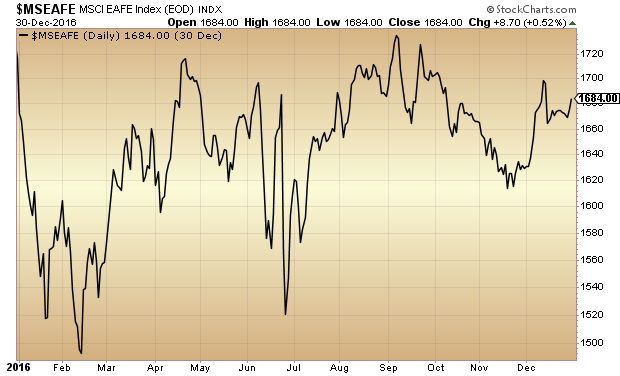
Given economic and political uncertainties across the globe, the international investment landscape remains challenged. Venezuela declared a state of emergency as its economy slid into crisis in January. China cut bank reserve requirements in February. Eurozone cut rates to zero per cent in March. June’s Brexit vote only posed a bigger threat to the rest of Europe. Italy’s referendum defeat in December caused more anxiety with that country’s banks and, yet again, threatened the survival of the Euro. As would be expected, this was captured in part by the volatile result of the MSCI EAFE Index ($MSEAFE), which closed 2016 down 1.9 per cent (US$).
Fixed income and interest rates:
Bank of Canada Governor Stephen Poloz kept the benchmark interest rate unchanged in 2016 at 0.5 per cent. While the apparent stabilization of oil prices and Canada’s improving export numbers are reason for optimism, the economic damage the oil rout caused remains visible. Poloz sets a high bar for any rate increase anytime soon. By contrast the U.S. ended 2016 with a further 25 basis point bump in the federal funds rate, and more increases to come given an improving, productive outlook.
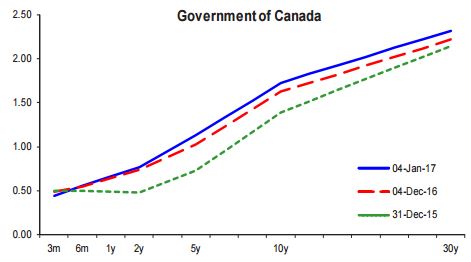
The domestic yield curve shifted upward with the 2-year and 10-year Government of Canada benchmark bonds at 0.75 per cent and 1.72 per cent, respectively. With Trump’s expected inflationary policy, even more dramatic was the 10-year U.S. Treasury yield which hit 2.45 per cent, up nearly 1.00 per cent from this summer’s low. Bond yields move inversely to prices, rising as they fall.
With rate expectations on the rise, demand for bonds pulled back. The FTSE TMX Canada Universe Bond Composite Index finished up only 1.7 per cent on the year. Adding maturity risk by extending term generated little extra return this year. The Long Composite Index showed a paltry 2.5 per cent.
Currencies:
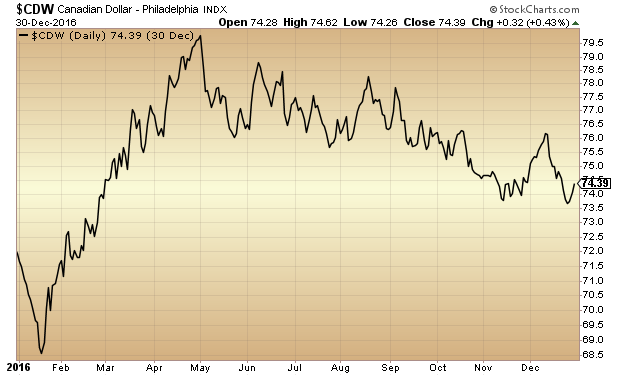
The link between the price of oil and the Canadian dollar remained strong for the first part of the year. The loonie came close to the $0.80 mark relative to the greenback. This relationship broke down, however, as monetary policy north and south of the border continued to diverge. The Canadian dollar took a hit as its U.S. counterpart surged on strong global demand for its bonds. The Canadian dollar ended the year worth $0.74 per U.S. dollar.
Theoretically a weak Canadian dollar should act as a catalyst for the domestic economy as our goods and services become attractive globally on a constant currency basis. Despite this—and bewildering many economists--Canada continued to record a trade deficit. The winds may be shifting, however, as the most recent data (November 2016) showed Canada recorded its first trade surplus since September 2014. This is definitely a positive sign. Many forecasters remain cautious, though, given President-elect Trump’s trade policies and the impact, if any, on Canada’s future relationship with our largest trading partner.
Commodities:
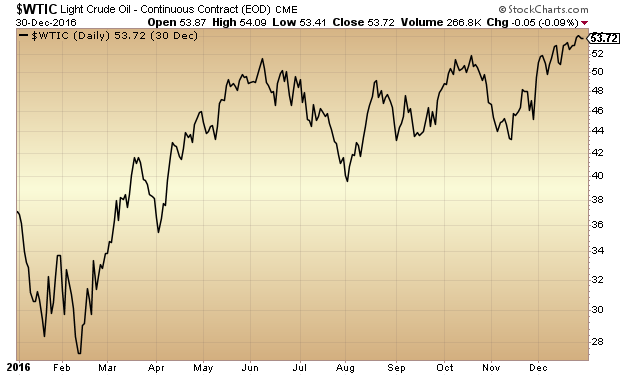
West Texas Intermediate ($WTIC) light crude oil dropped below US$27 per barrel in February. Against a backdrop of relatively healthy demand, a slowdown in the oversupply, and the eventual reaching of the OPEC production cut deal, 2016 saw WTI climb to US$53.72 per barrel, up 45.0 per cent. The consensus view sees oil holding fairly steady through 2017 as the oil price supply-demand dynamics play out, with prices in the US$50 to US$60 range.
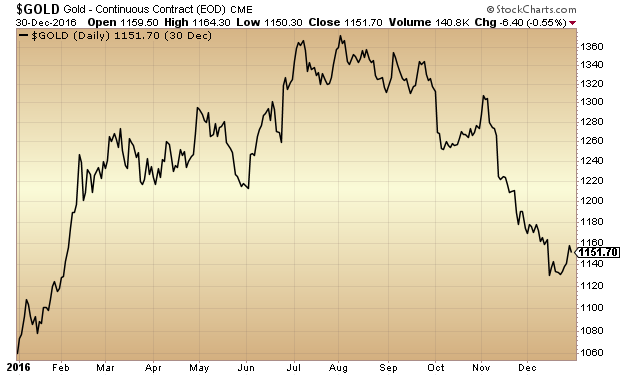
Gold, often considered a safe haven asset in times of uncertainty, took investors on a wild ride this year. Gold started the year at US$1,060 an ounce, but with surprises galore it quickly shot up and drifted ever closer to the US$1,400 per ounce mark. With the sentiment-shift following the U.S. presidential election, investors’ risk appetite increased. The demand for gold dropped precipitously as did the price. Gold ended the year barely ahead of where it began at US$1,152 per ounce.
This report is provided for your information. Conclusions and opinions given do not guarantee future events or performance. Facts and data provided are from sources we believe to be reliable, but we cannot guarantee they are complete or accurate. This report is not to be construed as an offer to sell or a solicitation of an offer to buy any securities. Before making an investment or adopting an investment strategy, each investor should review his investment objectives with their investment advisor. Watson Di Primio Steel (WDS) Investment Management Ltd. and individuals and companies who are related may, at any time, buy or sell securities that are hereby described in this report.