
“Whenever you hear a discussion about the short-term swings in any given stock’s price, your immediate thought should be whether it matters to why you are investing.”
— Barry Ritholtz, The Big Picture blog
The Greek debt saga and our range-bound markets
The first half of the year had its share of challenges and market-moving news, not the least of which was the surprise rate cut coming from the Bank of Canada in late January. As the threat of slower growth began to emerge, central bankers around the world (e.g. ECB, China, Japan, India and Australia) intervened with rate cuts and other measures of their own. The threat of lower energy prices bringing more deflationary pressures became a theme in central bankers’ commentaries.
Despite a weak start to the year in the U.S. caused by weather-related issues and strikes, recent data paints a brighter picture of improving fundamentals. Recent improvements in labour markets are seen as further catalysts for momentum in the U.S. economy. Concerns from the weaker-than-expected first quarter are subsiding as the consumer and housing sectors heat up; offsetting oil-related pressure and weaker exports caused by the strong U.S. dollar. With this recent momentum, many are looking to the U.S. Federal Reserve (“Fed”) for a possible September interest rate increase.
Housing and consumer spending in Canada have remained relatively resilient; while continued strength in the U.S. economy--coupled with the low Canadian dollar – should lead to marginal increases in domestic export activity. Unfortunately April saw the Canadian economy unexpectedly shrink for the fourth consecutive month; so now some economists see a potential risk of another rate cut here. This is not a consensus view, as many others feel the likelihood is low and question the effectiveness of further rate cuts on the hardest hit sectors.
Expectations point to a return to global growth for the second half of 2015, albeit muted. Even so, there is no lack of concerns weighing on investors’ minds, especially the Eurozone crisis as Greece became the first developed country to default on an International Monetary Fund loan. Fears of a possible “Grexit”, or Greek exit from the Euro, weighed on the markets at the end of June, erasing first-half gains. Greek uncertainty may lead to further market volatility; however, it is fair to assume that after five years the markets have already digested this outcome to some degree.
The result of the first half of 2015 is the directionless markets to date: volatile, range-bound, and searching for a meaningful catalyst. Although growth may be muted in the near term, we believe that we’re in the midst of an extended business cycle and the probability for recession in North America is low.
As always, we thank you for your support and continued confidence in WDS.
Equities:
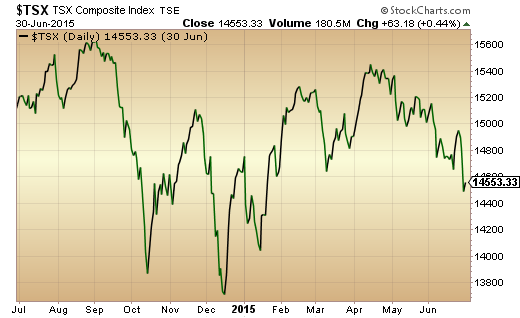
The Canadian S&P/TSX Composite Index ($TSX chart) started at 14,632 and closed the first half of the year down at 14,553, for a slight loss of -0.5 per cent. Including dividends (total return) the TSX was up 0.9 per cent year to date. With continued pressure on commodity prices, energy and industrials were the losers down 7 per cent and 8.8 per cent, respectively. Consumer discretionary and health care were the bright spots for the Canadian markets with 6.8 per cent and 58.3 per cent gains on a year-to-date basis. The health care sector was dominated by the performance of Valeant Pharmaceuticals.
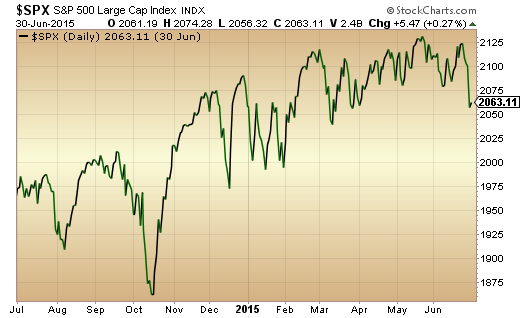
South of the border saw markets end June mostly flat with the S&P 500 Index ($SPX chart) closing June at 2,063 after starting the year at 2,059, for a slight gain of 0.9 per cent. The continued strength of the U.S. dollar resulted in the S&P 500 Index seeing an almost 10 per cent return in Canadian dollars. Sector performance had the same flavour as the Canadian markets with energy lagging and consumer discretionary and health care outperforming the rest of the market.
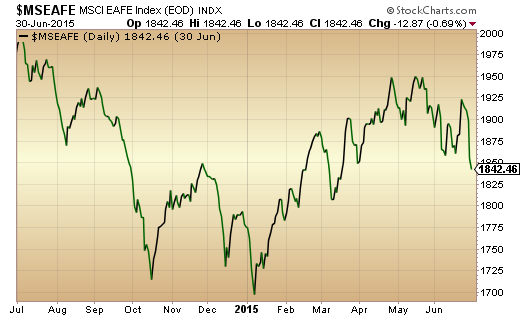
For a broader global picture, the MSCI EAFE Index ($MSEAFE chart) was up 4.6 per cent (U$) on the year, excluding dividends.
Fixed income and interest rates:
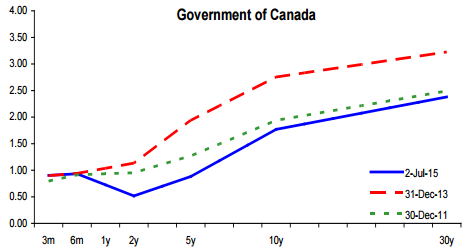
In a surprise move, the Bank of Canada reduced its benchmark interest rate early in 2015, which caused the already low Canada 10-year bond yield to slip from 1.78 per cent to 1.42 per cent within days after the cut. Things edged higher from this low and by the end of June the 10-year Canada rate was at 1.88 per cent. The FTSE TMX Canada Universe Bond Composite Index posted a 2.37 per cent return for the first half of 2015 and the Long Composite Index saw a return of 2.25 per cent over that period. With the U.S. Fed expected to raise rates sometime in 2015, it has renewed concerns of another “taper tantrum” event; rising yields and declining bond prices. Slow global growth, continued appetite for safer assets, and high levels of monetary stimulus in other economies should help to reduce the case for an overly aggressive increase in interest rates.
Currencies:
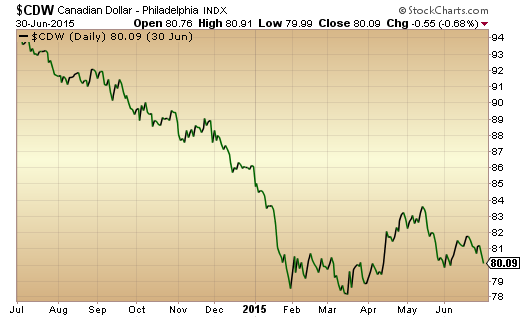
The Canadian dollar that ended 2014 at $0.86 versus the U.S. dollar entered 2015 already carrying downward momentum. Early 2015 saw more weakness as the surprise Bank of Canada rate cut led to further declines in the loonie, making its way below $0.80 later in January and staying within a few pennies for the next few months. Not long after reaching a peak in mid-May above $0.83, the Canadian dollar slid again on the surging U.S. dollar, closing June at the $0.80 level.
The surprise contraction of the Canadian economy and a seemingly stalled oil rally are likely suspects in our dollar’s weakness. With the U.S. expected to raise rates this year--while analysts expect Canadian rates to stay the same or go lower--Canadian dollar weakness may continue, at least for the foreseeable future.
Commodities:
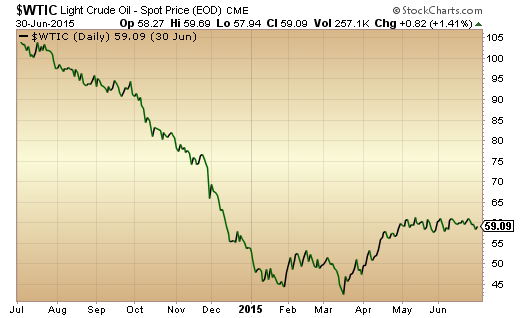
2014 saw West Texas Intermediate (WTI) light crude oil tumble almost 50 per cent closing the year at US$53.71. Further news of a supply glut had WTI off to a rocky start in 2015, hitting new lows in mid-March at just above US$42 per barrel. Oil prices gained some momentum off these lows approaching the US$60 range by May. Continued oversupply concerns have kept oil trading in a fairly tight range since the recent run-up, with WTI closing out June at US$59.09 ($WTIC chart).
Oversupply is the theme. The question is how long until the supply/demand imbalance begins to narrow, bringing prices up with it. The evolution of shale production in the U.S. caused their production to see a near two-fold increase over the past five years, which was not met with the same level of consumption growth. With prices depressed producers are slashing investments, idling equipment, and taking more expensive wells out of production; so the supply and demand sides may find a new equilibrium price soon.
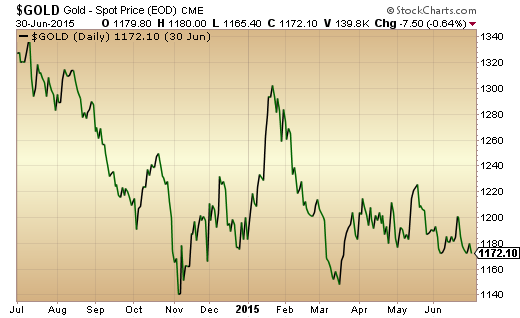
Starting 2015 at US$1,183 an ounce, gold had a run-up early in the year to over US$1,300 an ounce by late January. This proved to be temporary as mid-March saw gold plummet again below US$1,150 per ounce. The first half of 2015 ended with gold down slightly from the beginning of the year at US$1,172 an ounce. 2015 is also proving challenging for other precious metals and industrial commodities with silver, platinum, copper, zinc, and nickel all down on the year.
This report is provided for your information. Conclusions and opinions given do not guarantee future events or performance. Facts and data provided are from sources we believe to be reliable, but we cannot guarantee they are complete or accurate. This report is not to be construed as an offer to sell or a solicitation of an offer to buy any securities. Before making an investment or adopting an investment strategy, each investor should review his investment objectives with their investment advisor. Watson Di Primio Steel (WDS) Investment Management Ltd. and individuals and companies who are related may, at any time, buy or sell securities that are hereby described in this report.